
 2 weeks ago
17
2 weeks ago
17
When Emmy Meli last spoke to BEST FIT, it was three years after the release of her 2021 breakout single “I AM WOMAN”. As the track gained a significant presence on TikTok, resonating widely for its bold, anthemic affirmations of self-love, the California singer shot to viral fame, accruing millions of streams while being positioned as a voice of female empowerment.
And while Meli effectively became a key artistic figure within the Gen Z feminist movement, inspiring a reclamation of confidence and femininity among women everywhere, she admits that the song didn’t come from a version of herself that wholly believed the message that she was conveying. Rather, the lines “I am woman, I am fearless, I am sexy, I’m divine,” were written for a young, timid Meli, who needed those assurances at the time.
“I was so deeply insecure and scared of my own shadow,” the now 26-year-old admits. “I had no idea who I was, who I was as an artist, and what I wanted to say. It was like this message had been channelled through me that I didn’t know what to do with.”
At only 21-years old, Meli had suddenly and inadvertently become a source of encouragement towards a self-appreciation she’d yet to uncover herself, which ultimately led to a conflicted relationship with the success brought on by the song. “I was so young. I was 20 when I wrote the song, and 21 when all of this stuff happened, and I think I actually rejected it,” she explains. “I remember a lot of people looking to me for advice on empowerment and confidence that I couldn’t give them.”
Get the Best Fit take on the week in music direct to your inbox every Friday
“It makes no sense, considering I wrote the song, right?” she laughs, continuing, “I totally rejected this position from the universe. Like, ‘Here you go, you get to empower people.’ But what the hell do I know about that? I know nothing about that. But I think I actually wrote that song not just for other women to heal to it, but for myself to heal with them, and I didn’t realise that was going on.”
With this new and unexpected sense of responsibility to respond to her sudden audience, Meli was deeply entrenched in imposter syndrome. “I had it so bad that I think I really did sabotage my own success to a certain degree,” she reveals. “But I was also getting massively cyberbullied online. Looking back, I thought I was an adult, but I was a child with no idea of how to handle this mass following, success, attention, and hatred being hurled my way for no reason.”
Eventually, she began to lean into the hate she received, using it as justification to remove herself from the limelight. “I found truth in what haters said to me, because it gave me an excuse to hide,” Meli admits. She specifically reflects on a moment when she attended the Billboard Women in Music Awards in 2022, and found herself walking the red carpet between Normani and Aly & AJ. “I was thinking to myself, what am I doing here? I don’t belong here,” she tells me of the experience. “I was trying not to walk the carpet because I was so nervous, scared, and insecure. I didn’t even want my photo taken.”

“I was afraid of my own success, afraid of the power that my true self could possibly bring,” she adds. “And how can you expect to embrace success if you don’t believe that you truly deserve it?” Meli notes that her understanding of success is reflected in her ability to be authentic, which, for a while, became muddled in the noise around “I AM WOMAN”. “I think the song totally overshadowed who I was as an artist,” she explains“It didn’t even really give me the chance to say, ‘Hey, you know this song, but do you know me?’”
But since then, things have changed. In 2024, Meli went on to release her debut EP, Hello Stranger, a seven-track collection which allowed her to present a coming-of-age story which spanned seven years, delving into themes of personal growth while offering a more vulnerable entry point into her sound. Now, as she gears up to release her second EP, All About Love, she can acknowledge the transformative effect of truly looking inward for the first time.
When I ask Meli about how she feels about where she is now versus five years ago, she tells me that it’s a question that's been fresh on her mind. “I’ve been reflecting on that really recently in my journal. I write five pages every morning, and it literally just came up in this last week where I was thinking to myself what a different person and artist I am now,” she says, with a wash of both relief and conviction.
To make that change, Meli had to get honest with herself, separating from things that filled voids in what she has described as an “ego death”, and take a step back. “I had to replace these voids I was trying to fill with superficial things,” she admits. “Whether that be friendships, jumping from relationship to relationship, or feeling relevant in pop culture, I was chasing something that I needed to find within myself.”
For two years, releasing music took a back seat while Meli embarked on her own journey of self-discovery. She began to prioritise her spiritual practice, engage with hobbies, decentre men, and silence the echo chamber of public opinion. “My whole life fell apart in order for me to rebuild it the way that it needed to be rebuilt,” she asserts. “I had to have this massive ego death and lose everything to really think about what I want, and what it is I want to say. And when I started replacing those voids with things that I already knew existed within me, I could hear myself better, I knew myself better. I found my wholeness.”
For Meli, finding wholeness came through learning how to be alone. She was reading books, riding horses, and as she explains, “facing the part of myself that I was so afraid to face.” She laughs upon reflection, adding, “I just slowly started to notice that I thought I was cool.”
An important part of this process came through documenting her own journey towards this realisation on All About Love. Inspired by author bell hooks’ 1999 book All About Love: New Visions, a copy of which she received from a friend’s mother, Meli found herself translating hooks’ words into a practice. It completely shook her perspective, so much so that she went on to read the entire trilogy.
“It made me completely rethink how I went about making decisions,” she explains. “Because I don’t think a lot of people realise that even when it comes to what we wear when we get up and get dressed every day, it’s like, ‘Am I dressing this way because I feel like it’ll give me validation? Am I doing this because I feel like it’ll give me validation? Was I friends with those people because I thought they gave me validation?’ This patriarchal society has, I think, truly inhibited us from knowing ourselves as women and knowing whether our decisions are authentic or not, whether our friends are authentic or not, and whether our relationships are authentic or not. Our idea of love is so skewed because of the way we’ve been conditioned to think.”
All About Love sees her unpacking this conditioning, and the self-hurting patterns she’d internalised. “I questioned whether I even liked people I’d dated, and I thought about how a lot of friendships I had in the past weren’t genuine, because I think society tends to pit women against each other, and we can’t even see that. So it made me think, how am I ever going to unpack the fact that we all have this internalised misogyny if I don’t admit to myself that I’ve spent the last four years comparing myself to other women.”
Instead, on the upcoming EP, produced by Swindle, Meli finds herself looking to resolve her relationships — not with men, but with herself and other women. The project centres around her female friendships as opposed to her romantic world, creating distance from the idea that her sense of self is defined by romantic relationships. “I don’t want to be in competition with other women,” she notes. “So I really started to centre my world around other women. Those I give to and receive from, my friendships, and my ancestral line, which has inspired me by giving me the gift of their leadership and hard work every day.”
But initially, the songs were never meant to be released. Meli wrote them as a sort of personal catharsis, without the pressure of presenting them to an audience. It signified a return to her original way of working, completely alone and unfiltered, utilising the same creativity that saw the birth of “I AM WOMAN”. “I made the songs as a personal release,” Meli tells me. “I didn’t write them because I was working on a project. I wrote them on my own. Obviously, my producer made these incredible beats, but in terms of songwriting, this is the first project where I’ve written all about myself without a co-writer. So I thought, damn, maybe I don’t need a cowriter. Maybe I can do this on my own.”

Over seven tracks, Meli carries her customary soulful cadence, exploring love from perspectives beyond traditional romance. Her most ambitious track, “The Zoo”, was born during a solo trip to Paris when she found herself navigating the modern dating scene as a single woman for the first time in a long time. After a less-than-subtle proposition from a man she barely knew — which, to his surprise, just put her off dating culture completely — she took the train to London the next day to write about it. “I was like, this is like a zoo. It is a zoo out here,” she laughs, discussing the context behind the song. Through musing about red roses and love poems over the reality of swiping through dating apps in a bid for connection, the track channels her frustration. “Am I crazy that I don’t want to be in this new dating culture?” she asks. “No one knows how to talk to each other. I want real romance.”
“Ego” takes this critique a step further, expanding it to club culture with a dance-club beat. “I want to have a love that has nothing to do with ego, where we’re equals and appreciate each other on such a deep level that it has nothing to do with what we’ve been told to value in relationships,” she explains, identifying her songs as a reflection of her true desires rather than solely glamourising the idea of love through hopelessly romantic scenarios. “To write about love from all these different perspectives made me a better writer,” she reveals. “It was a challenge to write about something that wasn’t just, ‘I love you. You love me.’”
Now that she’s in a grounded, empowered headspace, Meli views success with All About Love differently than she did with “I AM WOMAN”. “I want people to feel like they really know me now. I want them to be inspired to redefine what love means to them, to think, ‘It’s okay that I don’t want to compare myself to other people.’” She views it as a collective experience, hoping that listeners feel as though they’re part of a journey towards unearthing the best parts of themselves. “I want them to feel like it was this big group FaceTime. We’re all going through it together, and we’re healing.”
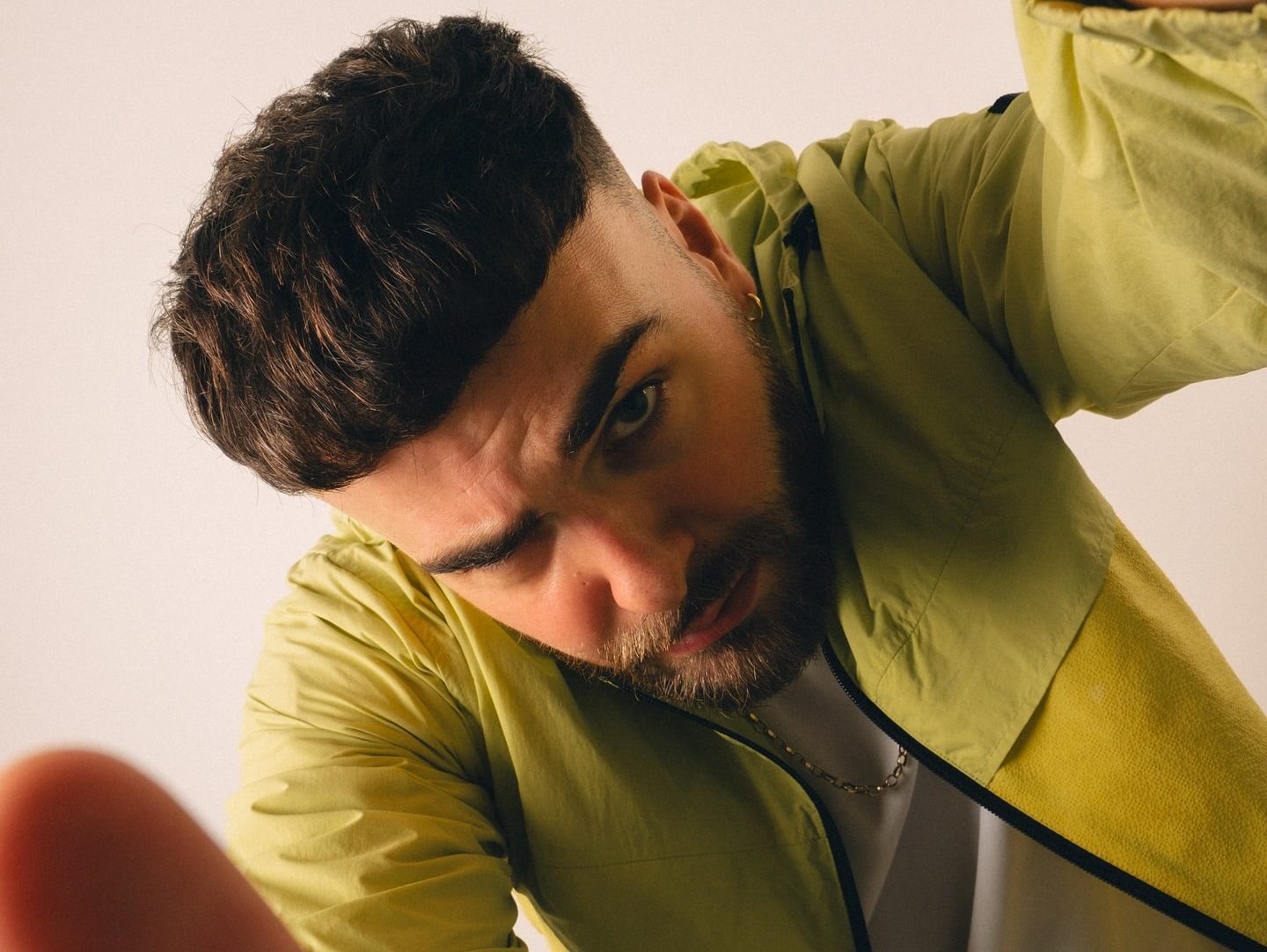
The person that Emmy Meli is now is a far cry from the frightened young woman writing songs to soothe herself, scrambling for a place to hide on the red carpet. Having taken the time to tap into what love actually means to her, effectively cracking a geode to reveal a sort of fragmented magic within, Meli has now found acceptance and opened a wealth of creative possibilities — beginning with her pop era. “I’m coming for my pop princess era this year,” Meli says, smiling when I ask her what’s coming next now that she’s made such a complete project. “I’m an independent artist now, so I’m feeling empowered to do whatever the hell I want.”
Finally, the seeds of fearlessness that Meli sowed years ago are coming to fruition. When I point this out, she pauses, before emotionally reflecting: “I wish I could give that girl a hug so badly. I think I’m the person now that I needed then, which I’m really proud to say. I feel like I’ve done so much work healing my mind, body and spirit these last five years, and it’s made me a better artist. I know that there’s this whole argument that you can’t make art without pain, but I think my healing has made my art better. And for the first time, I can confidently say that I know who I am as a person, and I know who I am as an artist.”










 English (US) ·