
 1 month ago
22
1 month ago
22


Madison Cunningham was 27 years old when she felt truly alone in the world for the first time.
The relationship that followed her from teenagedom to adulthood was over, and the independence she had been chasing since her move to Los Angeles in 2017 was far more quiet and painful than she imagined.
Nothing seemed to come easily to Cunningham anymore. Music didn’t sound the same, writing lyrics felt like a punishment, and when she wasn’t channeling sadness, anger, or grief, she was completely numb. As she re-learned to take her first steps, uncoordinated and afraid, Cunningham realised that she may never feel these feelings ever again – the agony of losing a great love and the clarity gained from starting over.
Cunningham spent the latter half of 2024 writing Ace, her third solo record. Released in October 2025, Ace is Cunningham’s way of memorialising this transitional moment in her life. Each song is a direct address, unsaid words to people she may never speak to again. For Cunningham, Ace was a risk she had to take to be authentic in her craft.
Cunningham joins our call from a hotel room in Seattle, where she played a show the night before. She wears a leather jacket and a grey baseball cap over her auburn hair. Cunningham is excited by the gloominess of Seattle, a departure from Southern California in January.
Get the Best Fit take on the week in music direct to your inbox every Friday
Last night, she played Saint Mark’s Episcopal Cathedral, where concertgoers filled pews and brought blankets to sit on the floor. “It was just the most beautiful venue I’ve ever played in,” she says. “And I could tell it sounded beautiful.” Cunningham began her music career at her dad’s episcopal church in Orange County. She performed in a praise band on Sundays, but playing secular music at church is a completely new feeling. “Everybody is so reverent,” she says. “The shows are so pin-drop quiet.”
It’s no surprise that Cunningham writes songs for a living. She is incredibly articulate in lyrics and speech, an elegant and thoughtful conversationalist. “I’m just the dumb homeschooled kid that’s trying to find words,” she chuckles. I feel quite the opposite; Cunningham can put words to a feeling better than most.
Cunningham was 20 years old when she relocated to LA from Orange County. A pastor’s daughter and the eldest of five sisters, she committed to pursuing music full-time. “I was toggling between, ‘Do I actually go to school for music, or do I do the thing for real and just pack my bags and see what’s out in the city for me?’” Cunningham was already driving to LA four or fives times a week to record, so signing a lease felt like the natural next step. A year later, Cunningham was married to her high school sweetheart and laying roots in her new city.
In 2019, Cunningham released her debut record Who Are You Now, which received a Grammy nomination for Best Americana Album. Who Are You Now cemented Cunningham as an exciting new voice in folk rock, with a self-assured, jazzy sound and a gift for colourful storytelling.

Fan favorite track “Song In My Head” is catchy, energetic, and still, deeply personal. In the bridge, Cunningham sings, “Information, education, given in love / Questions digest like sugar in my blood.” Her childhood, which revolved around the church, sheltered Cunningham and left her with an unsettling amount of curiosity.
Three years later, Cunningham released Revealer, which won the Grammy Award for Best Folk Album. Lead single “Hospital” is a COVID-era anthem of insanity and information overload, shrouded in electric guitar licks and a foot-tapping chorus. She sings, “Checkin’ into a hospital / Where the nurse is earth and sky / Fighting against my flesh and blood / There’s nothing I won’t try.”
Between Revealer and Ace, Cunningham toured with Hozier, John Mayer, and Juana Molina, made several appearances on late night television, and recorded a cover album with Andrew Bird. Cunningham Bird, released in 2024, is a track-by-track tribute to Buckingham Nicks, the 1973 record from Fleetwood Mac’s Lindsay Buckingham and Stevie Nicks.
In 2024, Cunningham had hit her stride musically and her career was blossoming. All the while, her personal life was turning upside down. Cunningham and her husband chose to divorce, and the stable home they had built together was unraveling. “I would be lying to myself if I said that that restructuring of my life wasn’t completely devastating to everything that I knew about myself,” she says. “It changed everything. It couldn’t not.”
Cunningham reflects on the duality of her experience with heartbreak. “In some ways, it felt natural. I knew how to slide into it and embody it,” she says. “And then in other ways, I just felt like I wanted to cower. I just felt so klutzy to be a single person for the first time at 27-years-old.” While she had lived away from home since her early 20s, Cunningham always had a partner in her independence. She never knew the sinking feeling of returning to an empty house.
In many ways, Cunningham’s divorce made her feel like a helpless child. “There’s a naivety that you’re allowed to have in those moments – at any moment you choose to start again, no matter what age,” she says. She boils down this naivety to “fear or wide-eyed curiosity.” Perhaps, it’s a bit of both.
With the absence of a relationship came a sense of control and ownership over Cunningham’s next steps. “It was the key that opened up all the other things that I felt like I wasn’t allowed to feel or say out loud,” she says. “There was so much power in this. So much new blood and new energy.”
At first, Cunningham was hesitant to write songs about her divorce. “I really wanted it to feel like I was expressing myself truthfully, but also leaving room for the other perspective,” she says. Ace is not a puff piece nor a revenge album. Instead, Cunningham seeks to honour this closed chapter of her life, in its highest and lowest moments.
Cunningham wrote Ace over the course of just a few months. The bulk of the album poured out of her just two months before she was set to record with producer Robbie Lackritz (Feist, Bahamas, Peach Pit) at Allaire Studios in the Catskill Mountains of Upstate New York. “I just knew that I was never going to forget that period of writing,” she says. It was such a blur and also so deeply clarifying. Like, that was all I was thinking about and all I was doing.”
Together, Cunningham and Lackritz built the world of Ace as an expansive green forest through complex instrumentation. The tracks are piano-forward, the solid ground beneath the tree trunks. Cunningham has established herself as a skilled guitar player, but her first instrument – the one she always comes back to – is the piano. Above are the thick, twisted branches, sprawling with leaves of woodwinds and strings.

In the months she spent writing Ace, Cunningham struggled to listen to music, besides country. “I considered myself not a country music fan, and then someone had made me this playlist, and I just rinsed myself in it,” she says. “Country music holds this really profound sadness, but it’s wrapped in this very jolly package. For some reason, that combination allowed me to listen to music.”
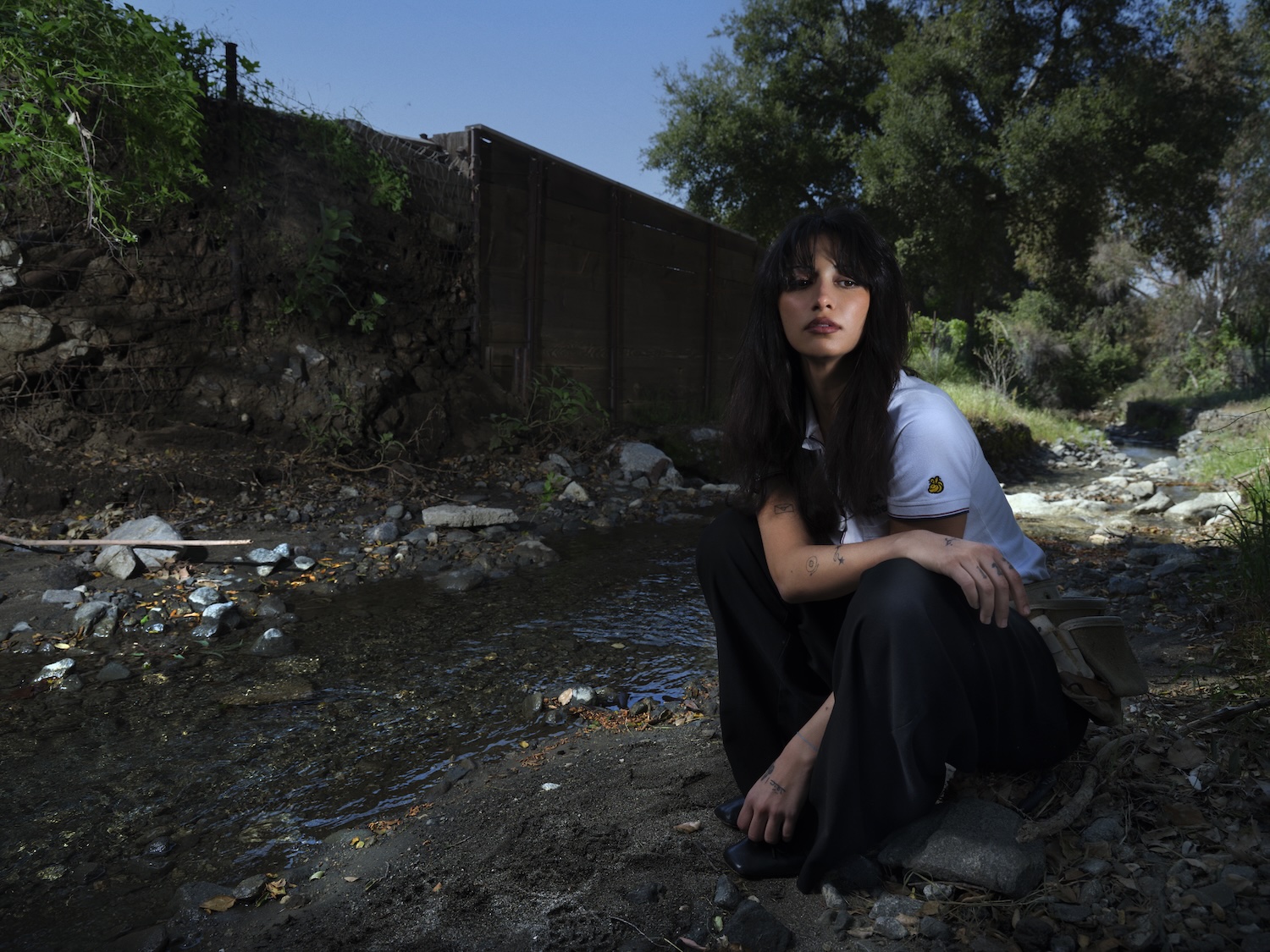
When she wasn’t squeezing the juices from her country playlist, Cunningham drew much artistic inspiration from nature. The river trail behind her house in Frog Town “became very lush out of nowhere,” which was either a beautiful coincidence or an omen. She would stand in the grass and listen to the birds coo, learning to distinguish between their calls. “I was very connected to nature in a way that I would almost mock myself for,” she says. “I was just looking for signs everywhere because I felt so directionless.”
Lead single “My Full Name”, the first song written for the record, is Cunningham idling at the foot of this metaphorical forest before bearing the harshest, most painful emotions. The words fell onto a page one afternoon, all at once. In the second verse, she sings: “There’s a water leak the size of Berlin / Coming from this vessel that we’re in / Running from my eyes to your chin / Love’s a kind of sorrow worth saving.”
“My Full Name” is a love song, but at its core, it’s Cunningham holding on by a thread. “It’s this recognition that you can put your heart on a platter, and it’s necessary and important to do that. Otherwise, you’re lying,” she says. “But, you know that in doing that, it really does present the risk of the other person not joining you there.”
Cunningham describes the song as “the main artery” of Ace because without the true love she experienced, there would be no heartbreak. At her most loving, Cunningham sings delicately over piano alone. Though, when she admits defeat and withdraws, the song swells into an arrangement of flute, clarinet, and percussion. “The only way that I could get to the anger and the betrayal and the sadness in the other songs was through the valve of vulnerability,” she says.
The second song Cunningham wrote for the record was the midpoint, “Wake”, a conversation between partners nearing the end of their relationship. “It had to be a dance of two people saying it to each other to avoid any notion of revenge,” she says. Cunningham needed Robin Pecknold of Fleet Foxes to be the song’s second voice. “He’s the king of harmonies,” she says. “I knew [Pecknold] was going to figure out how to snuggle up to the vocal in the right way.”
In “Wake”, Cunningham and Pecknold wrestle with the earliest stages of grief: “In the California drought / We’re drowning.” The song’s strings are reminiscent of Sufjan Stevens’ acoustic ballad “Mystery Of Love” – mythological and airy, yet haunting. “Wake” features Cunningham’s favourite lyrics on the record, which exemplify the most hopeless pits of loss. “It hits me as I drive away / I’ll never see your hair go grey,” they sing. At this moment, Cunningham has wandered too far into the forest to retrace her steps.
Eighth track “Invisible Chalk” represents the deepest point of Cunningham’s forest of sorrow and overcoming. She finds a balance between anger and “that very earnest character of longing and wanting someone and feeling alone.” Like “My Full Name”, the song’s instrumentation intensifies with the emotion in Cunningham’s vocal. “Blind loyalty betrays you / Like yellow hills are gonna burn / You and I might never learn,” she proclaims at the song’s climax.

The song is soft and whimsical, yet holds a profound sense of emptiness. “Undressing, we laugh / At our pale naked bodies / And the closer you get to me / All the farther you feel,” Cunningham admits to her former lover. This sequence feels all too familiar for those who have fallen out of love. “I think we medicate with false intimacy, even though all we want is the real thing,” she says.
Ace contains two instrumental tracks: “Shatter Into Form” and “Shatter Into Form II.” The songs are primarily piano music, with whispers of a breathy woodwind arrangement. On tour, she and bandmate Jesse Chandler “stretch the songs out as far as they go,” using these interludes as moments of reprieve from the record’s heavy subject matter.
Cunningham borrows a lyric from fourth track “Mummy” for the titles: “Is that the origin meaning of divorce? / To separate yourself / Or shatter into form.” She identifies this process of shattering into form as the nucleus of Ace. When everything falls apart, the rebuilding can begin.
In the record’s conclusion, “Best Of Us”, Cunningham cuts through the trees to find a broader horizon. This song embodies the final stage of grief: acceptance. “I stow my baggage overhead / The pilot’s certain / The sky is clear for flying,” she sings.
Cunningham describes “Best Of Us” as “a flat plane,” a natural departure from the forest she was once trapped in. She recognises that the relationship is over, but it no longer feels like a tragedy. “I’m learning how to be alone and to not feel loneliness,” she says. “Those don’t have to be the same thing.”
In the months following its release, Cunningham is still adjusting to Ace being out in the world. “It’s been a really challenging record to live inside of,” she says. “I always thought that when people said that, they were being dramatic. I just didn’t think that it was still going to hold all of this emotional weight, and it really does.”
Is it possible to move on while rehashing these memories on-stage every night? Cunningham is still figuring it out. “They’re still alive in me, almost like radiation or something left over from a big explosion,” she says. “It feels like there are a lot of landmines around talking about this record and living with it.” She vacillates between wondering if she has said too much or little.
Still, Cunningham felt a responsibility to tell this story. Leaning into discomfort has allowed her to feel most honest as an artist. “I feel relieved that I got to make the record that I’ve always wanted to make and that I got to make it in the way we did and in the time that we did. It all felt miraculous,” she says. “I’m excited about seeing how it lives with people.”
The last two years have been completely transformative for Madison Cunningham. She endured life-changing heartbreak and loss, reimagining a future that once felt certain. Writing songs and taking long walks by the LA River allowed her to grieve, to leave the forest, to start again. “Grief can make you self-absorbed, and sometimes you have to be,” she says. “But it can’t be a forever place.” It all starts with that first step.









 English (US) ·