
 4 weeks ago
24
4 weeks ago
24
The band Tang Dynasty started in 1989, when New York-born Chinese American guitarist Kaiser Kuo moved back to the country of his parents' birth. (The actual Tang Dynasty began in 618 AD.) Before the modern internet, culture didn't flow as freely between China and the rest of the world, so when Kuo played some of his favorite Western artists for his new friends in Beijing, the impact was immediate and immeasurable. They had no choice but to start China's first heavy metal band.
"I introduced the other guys in the band to much of the music that would influence them (bands like Queensrÿche, for example), and I did come up with the name of the band," Kuo told the Death Metal Underground blog in 2008. "But they changed me as much as I changed them. Playing with Tang Dynasty, I really found that the fusion of traditional Chinese music and Western metal works: it's not something I ever tinkered with before co-founding Tang Dynasty."
G.H.Z., the vocalist and guitarist for the Atlanta heavy metal band Chariots Overdrive, remembers seeing Tang Dynasty play decades later, when he was growing up in China. "I was in maybe high school or middle school, something like that," he recalls. "But I didn't know that was metal. I just called them a rock band back then. And then I realized they were already doing heavy metal in the 1980s. That was a very interesting experience."
Chariots Overdrive is something like a reverse Tang Dynasty. G.H.Z. started the band shortly after finishing graduate school at Georgia Tech, filling out a lineup of fellow international students. The band has never been based anywhere but Atlanta, but everyone in Chariots Overdrive was born in China. Like Kuo in Beijing in the '80s, G.H.Z. had to introduce his bandmates – co-guitarist Y.Z., bassist Z.Z.Y., and drummer W.R.C. – to the classic NWOBHM and USPM that would serve as the foundation for debut album The End Of Antiquity. The result is as idiosyncratic and outsiderish as it is purely invigorating. Chariots Overdrive have been a breath of fresh air in an American trad metal movement that had begun to go stale.
The members of Chariots Overdrive all started playing music at an early age, but in China, that doesn't necessarily a portend a deeper appreciation to come. "For Asian children, you always learn some instrument when you are young," Z.Z.Y. says. "My first instrument was the violin, when I was 6 or 7. Actually, I don't think at that time it gave me a lot of interest in music."
"My experiences are pretty similar to Z.Z.Y," G.H.Z. adds. "He was asked to learn the violin. My parents forced me to learn the piano. I started when I was 4. That's a very stereotypical thing. You see all the Asian kids doing that. I'm one of them, but I'm not, like, super good, compared to those kids you see on YouTube. For classical music, I'm okay."
"For rock music, I think my introduction was the movie School Of Rock," he continues. "On Chinese national television, they put a movie on every weekend — an American or European movie, every Saturday, and I watched that movie with my parents."
With Jack Black's voice ringing in his head, G.H.Z. began to dive deeper into music, working his way through classic rock and punk before eventually finding his way to heavy metal. He fell in love with the New Wave of British Heavy Metal, not just Iron Maiden and Angel Witch but "things where the band only has, like, one single." The closer the band was to being completely forgotten, the more they'd inspire him: "I like wasting my time by listening to those obscure bands," he says with pride.
Meanwhile, the players who would eventually join G.H.Z. in Chariots Overdrive were on their own musical journeys in their respective hometowns. W.R.C, Z.Z.Y., and Y.Z. all played in school bands. W.R.C. remembers playing Radiohead and Green Day songs with his band, and Z.Z.Y. introduced some original alt-rock compositions to his cover band's repertoire. Y.Z. played pop tunes with his undergrad band, but back at his dormitory, he was teaching himself fingerstyle guitar, striving to play the American jazz and blues he loved. None of them ever played metal in China.
As it turned out, that wasn't an issue. The earliest iteration of Chariots Overdrive was a series of informal jams centered on G.H.Z., Y.Z., and the band's former drummer, Z.L.H. Y.Z. recalls that he and G.H.Z. first became friends through their shared master's coursework, not through music. "He's the one who would usually take me around to the Chinese restaurants when I didn't have a car," Y.Z. says. "He knew that I could play guitar, but at that time, we didn't really start a band. I'm not really a metalhead. The first metal show I went to was Manilla Road during school, which G.H.Z. took me to. When joining this band, I asked him, 'What should I play?' He says, 'Do you remember Manilla Road? Just play like that.'"
"It was me and our first drummer, and we were like, 'We need another guitar player who can play all the crazy solos,'" G.H.Z. says. "We immediately thought of Y.Z., and we invited him. So there was three of us. Then we needed a bass player." Z.Z.Y. entered their lives shortly after, when he hit up the Georgia Tech group chat on the Chinese messaging platform WeChat to ask if anyone else was going to see a show featuring local black metal band Cloak. G.H.Z. responded, they met up at the gig, and Z.Z.Y. joined the fold. In the summer of 2023, Chariots Overdrive was born.
At first, the band had no intentions of releasing their own music. The jam sessions were fun and loose, and the members simply enjoyed one another's company. Almost in spite of themselves, original material kept coming out. "For most of the bands [I was in], they are not doing new songs. They will cover something," Z.Z.Y. recalls. "But when I went into the first rehearsal, they were not covering anything."
"It was quite natural for me, because every time we rehearsed, we got something new," Y.Z. confirms. "It's not like someone writes a song, and we're just playing the song that somebody else wrote. It's more like everybody has some ideas during jamming, and everybody contributes to the flow, and it feels really good, the chemistry. We just rehearsed regularly, more and more. We have songs, and we think they are good, [so we thought] we should really refine it and release it."
The first Chariots Overdrive release was a demo, When The Wheels Start, featuring Z.L.H. on drums. When Z.L.H. moved away from Atlanta, W.R.C. replaced him in the band, and they quickly wrote the rest of what would become The End Of Antiquity. (Despite never being in the band at the same time, Z.L.H. and W.R.C. are coincidentally the only Chariots Overdrive members who had met each other back in China.) They decamped to Meadowlark Audioworks in suburban Atlanta to record with Greg Hendler, an old classmate of G.H.Z. and Y.Z.'s. Things clicked right away.
"Greg is very knowledgeable," Z.Z.Y. says. "He knows how to get to the tone we want. He's quite professional, and also, I think he provided a lot of constructive advice during the recording. Maybe change some notes to make all the different bass lines and guitar lines fit better, or how to choose the notes for the choirs for the backing vocals in some songs."
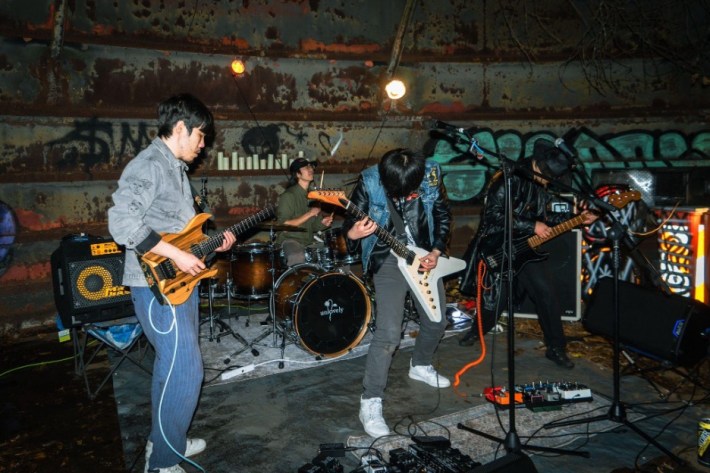
The End Of Antiquity is truly killer, especially for a debut. It's a raw, eccentric heavy metal odyssey that's indebted to Paul Di'Anno-era Iron Maiden, Kai Hansen-era Helloween, Manilla Road, Cirith Ungol, Heavy Load, and Metalucifer — without ever sounding too much like any of them, except in fleeting moments that dissipate like vapor as soon as you think you've identified the reference point. Short, punchy anthems like "Parasite" and "Marching Maniacs" hit with violent force, while stranger, more esoteric cuts like "A Taikonautic Alchemist" and "A Bizarre Pilgrimage To The Cubik Mansion" meander down winding roads of warped melody. "A Bizarre Pilgrimage," in particular, is a doozy. At 12 minutes, it's easily the longest song on the album, and it brings in ideas from well beyond Chariots Overdrive's typical pool of influences.
"Maybe three years ago, we tried to play something like Saint Vitus or Reverend Bizarre, and that's when Z.Z.Y. came up with some very slow doom riffs," G.H.Z. says. "We were like, maybe we can put that in a section. Maybe not a full song, but a section."
"And then we have the structure," Z.Z.Y. continues. "We decided we will have the first riff of that song, and then we will need to find a connection between different sections. So, we will have the second and third part to make the first one [sound] completed. And then, we found that the doom riff may not sound very good as an ending, so we added the last part. It's like, brick by brick, we build a wall."
The lion's share of the lyrics on The End Of Antiquity are rooted in Chinese history and myth. The references aren't laid out on the surface, though, so someone who isn't intimately familiar with Chinese culture isn't likely to figure out precisely what G.H.Z. is singing about. That's completely intentional. "If a Chinese person reads our lyrics, they can figure out what we're talking about, even though we don't mention any names there," G.H.Z. says. Maybe I need to spend some more time with Romance Of The Three Kingdoms.
Even if you can't identify the stories on The End Of Antiquity, it should be clear that Chariots Overdrive approach heavy metal from a unique, honest angle. Call it heavy metal with Chinese characteristics — deeply informed by the border-obliterating power of classic metal, but indelibly shaped by the personal and musical histories of the four men who made it.
"We feel like we don't have to be 100% metal," G.H.Z. says. "Y.Z. was a great jazz player. He can bring some influences from the other side. We'll make our band a little bit different to other metal bands."
"But G.H.Z. will make sure we are still the true metal," Z.Z.Y. is quick to add. "We are not going to become a progressive metal band, or something very New Wave. He keeps it old-school. We're just adding more elements. We don't want to be a pure cliché. We still want to have a unique style."
TEN NAILS THROUGH THE NECK
10
Father Dionysios Tabakis – "Ἠλεκτρικαὶ Ὑμνωδίαι – Α΄ Ἑωθινὸν μὲ ἠλεκτρικὴν κιθάραν ἄνευ τάστων (perdesiz)"
Location: Nafplio, Greece
Subgenre: drone metal/devotional
There is, at most, 10 minutes of metal on Paradise Metal, the debut album by 53-year-old Greek Orthodox priest Dionysios Tabakis. It's mostly played on the perdesiz, a fretless guitar from Turkey that lends itself to eerie, nonintuitive microtonality. When Tabakis plays the perdesiz, he's engaging with Byzantine music and the devotional music of his faith, yes, but he also sounds like he at least knows about Earth and Sunn O))). Grayson Haver Currin wrote a great review of Paradise Metal for Pitchfork where he rightly asked if the fascination around Paradise Metal – it's been a Bandcamp top seller for a month – is fetishization as much as it is appreciation. I think it's undeniable that these sounds wouldn't be finding their audience without the novelty factor, and it helps that the faux-private press cover art of Tabakis wielding his axe against a Photoshopped blue sky lends itself to easy memeing. But the perdesiz drones here are genuinely moving, both in their sheer heaviness and in the palpable sense that they're being performed in service of Tabakis's deep religious devotion. Beats the hell out of Hillsong, anyway. [From Paradise Metal, out now via Heat Crimes.]
9
Dimhav – "Tides Immemorial"
Location: Stockholm, Sweden
Subgenre: symphonic/progressive power metal
Daniel Heiman has sung on several of the greatest power metal albums of all time, from his early 2000s run with Lost Horizon to his work on my favorite album of 2023, Sacred Outcry's Towers Of Gold. He's a technical marvel, the kind of singer whose octave count gets debated on the geeky vocalist message board the Range Planet. Most metal singers scraping the high end of their falsetto sound like King Diamond; Heiman sounds like Mariah Carey. He's been quiet since Towers Of Gold, but this month, he brought his nearly limitless range to the lushly orchestrated second album by Dimhav. Personally, I prefer his slightly grittier projects, but there arguably isn't a better fit for what Heiman can do with his voice than Dimhav. Brothers Olle and Staffan Lindroth are fiends for both progressive structures and symphonic arrangements, and they sometimes sound like they're challenging Heiman to keep up. He's game, of course, and Ondine is full of chances to appreciate the greatest power metal vocalist of all time at what might be a late-breaking physical peak. [From Ondine, out now via the band.]
8
A Forest Of Stars – "Ascension Of The Clowns"
Location: Leeds, UK
Subgenre: avant-garde/progressive black metal
They're too deliberately weird to ever reach a wide audience, but A Forest Of Stars deserve to be discussed among the great black metal bands of the 21st century. For nearly 20 years, vocalist Mister Curse has brought the stentorian sprechgesang of Devil Doll's Mr. Doctor to extreme metal, with clattering drums, freewheeling guitars, and deluges of violin, flute, and piano raging behind him. (The musician responsible for that violin and flute is Katie Stone, who played on the best My Dying Bride album of the past 25 years in For Lies I Sire.) The great Scottish band Ashenspire wouldn't exist without A Forest of Stars; nor would the late-period experiments of Pensées Nocturnes. Stack Overflow in Corpse Pile Interface is another inspired bout of insanity from the Leeds collective, and in truth, I've not yet been able to fully wrap my head around its hour-plus assault of discursive structures and dense wordplay. It's an album I look forward to checking in with throughout the year. [From Stack Overflow in Corpse Pile Interface, out now via Prophecy Productions.]
7
Balmora – "Moon Light Hysteria"
Location: New Haven, Connecticut
Subgenre: metalcore
I hadn't heard the term "angel statue metalcore" until Tom Breihan wrote it into Stereogum's announcement for the debut Balmora album back in March. That's exactly what this shit is, though, yeah. Melodic, dramatic, maybe vaguely Christian-coded metalcore that steals At The Gates riffs and Acacia Strain breakdowns with equal fervor, with solos that seem to burst forth from cracks in the ground at a haunted cemetery. "Moon Light Hysteria" reminds me a bit of Darkest Hour, but unlike Darkest Hour, I don't know if these guys give a shit about Judas Priest and Slayer. Time marches on, I suppose. I don't have a lot of love for modern metalcore, but Balmora – pardon the Priest pun – deliver the goods. [From These Graven Halls, out now via Daze.]
6
Panopticon – "Ghost Eyes In The Fire Light"
Location: Ely, Minnesota
Subgenre: atmospheric black metal
Det hjemsøkte hjertet completes a triumvirate of Panopticon albums reflecting on mainman Austin Lunn's life in his adopted home of northern Minnesota. The Laurentian Trilogy (which also includes 2021's …And Again Into The Light and 2023's The Rime Of Memory) never quite moved me as much as Lunn's earlier trilogy, which contained three no-shit modern classics in Kentucky, Roads To The North, and Autumn Eternal. It's not like the Laurentian albums ever sucked, though, and at their best, they still showed off the mastery of one of American black metal's great conjurers of atmosphere. The best song in the trilogy is the last one: Det hjemsøkte hjertet's closing track, "Ghost Eyes In The Fire Light," is a 14-minute epic with stirring tempo shifts, dense thickets of distorted violin, and guest vocals by alt-country singer Jordan Day. The whole thing plays out like one long crescendo, with Lunn working himself up to an emotional boil that peaks as the song reaches its haunting conclusion. As the last notes ring out, the Laurentian Trilogy fades away, and the ledger is cleared. I can't wait to hear where Lunn takes Panopticon next. [From Det hjemsøkte hjertet, out now via Bindrune Recordings.]
5
Nedgravd – "Black Blood Descension"
Location: Oslo, Norway
Subgenre: death metal
I know it's hacky to marvel at the youth of the musicians in what has historically been a youth-driven movement, but I genuinely don't know how a bunch of kids born after the invention of the iPhone managed to make something that sounds this ancient and evil. The members of Nedgravd are all between 16 and 19, and their brand of death metal is indebted to some of the genre's great "I" bands — Infester, Impetigo, Imprecation, Incantation. Vocals are low gurgles that bear only the faintest suggestion of human language. Riffs and drum patterns are rudimentary, and tinny keyboards and horror movie samples provide spooky contrast to the dudes bashing away at their instruments. Sharp execution is far less important than feel. The sloppiness is part of the magic. Would proponents of satanic blood sacrifice spend eight hours a day practicing guitar along to Archspire playthroughs on YouTube? No! They'd do blood sacrifices. On Ascension, Nedgravd sound like they've been down at the altar all day. [From Ascension, out now via the band.]
4
Dimmu Borgir – "As Seen In The Unseen"
Location: Oslo, Norway
Subgenre: symphonic black metal
If you've tuned out of the Dimmu Borgir experience for the past couple albums, it's time to tap back in. Abrahadabra and Eonian have their share of defenders, but even they might have to cop to Grand Serpent Rising sounding like a return to form. Dimmu have cranked the "epic" knob as far as it will go on this one, flirting with the 70-minute mark and, somewhat improbably, earning every second of runtime. Orchestral elements are woven into the fabric of the album without ever superseding Silenoz's searing riffs or Shagrath's vocals, which are mixed confrontationally high (but sound so good that I don't mind it.) Dimmu Borgir songs have always functioned like miniature operas, and the attention to detail that necessarily goes into that approach is on full display on Grand Serpent Rising. There's something new to discover and dissect in every moment, and only on repeated listens can you get something like the full picture. "As Seen In The Unseen" is a good testing ground for Grand Serpent Rising's more-is-more theory, and it passes that test with flying colors. The arrangement is massive and full of fine embellishments – tinkling piano, ghostly strings, pseudo-industrial processed vocals – but the visceral impact of the song isn't dulled in the least by its complexity. [From Grand Serpent Rising, out now via Nuclear Blast Records.]
3
Sabotør – "Skyggens Frekvens"
Location: Bergen, Norway
Subgenre: heavy metal/punk
Hey, here's a satisfying boot on the throat of the fascists poisoning the metal scene: a doggedly old-school, punk-infused heavy metal band dedicated to the Norwegian Resistance. During the five dark years that the Nazis occupied Norway during World War II, the Resistance infiltrated, sabotaged, fought, and frustrated the regime at every turn. Bergen's Sabotør celebrate their countrymen's heroics on their Norwegian-language debut album Første aksjon. It's a fast and dirty slab of NWOBHM that shares the ad-hoc aggression and righteous defiance of the Resistance. Every song here feels like a battle anthem, but the sharpest writing can be found on "Skyggens Frekvens," which sounds like late-period Darkthrone with even more Motörhead in its blood. It hurtles down its warpath with abandon, knocking over any Nazi stupid enough to stand in its way. [From Første aksjon, out now via Dark Essence Records.]
Location: Germany
Subgenre: avant-garde black metal
I, Voidhanger gonna I, Voidhanger. The Golden Citadel Of The Astral Sphere, the debut full-length by the anonymous German collective Junon, is an archetypal release for its eternally anti-archetype label. Junon is rooted in black metal, as most of the I, Voidhanger roster is, but at their best, their compositions feel nearly formless, with great yawning movements that act as playgrounds for reckless experimentation. "Dolorosa" closes The Golden Citadel with 21 gripping minutes that veer between minimalism and maximalism, drone and density, microtonality and metallic shred. Junon's unnamed, chameleonic vocalist has the charisma to pick up all these disparate threads and weave them into a coherent musical narrative. "Dolorosa" is unsettling, and it's engineered to be that way. That's the I, Voidhanger promise, and Junon happily fulfill it. [From The Golden Citadel of the Astral Sphere, out now via I, Voidhanger Records.]
1
Eternal Evil – "Forever Feared"
Location: Stockholm, Sweden
Subgenre: thrash metal
All the iconic '80s thrash bands either wound up playing arenas or wished they had. That's something the revivalist waves of the genre have mostly ignored. As metal has continued its slow retreat to the underground, bands have too seldom reached for the big-tent gestures that Metallica and Megadeth once rode to fame. I don't think Eternal Evil are going to wind up headlining Wacken, but on Forever Feared, they're writing and playing like they think there's a chance, and I think that's beautiful. The Stockholm band's third album is brash, audacious, and full of gigantic melodies that would sound great sung in unison by 20,000 people. The devilishly catchy title track could have come from the sessions for Kreator's 1999 album Endorama, which was maligned at the time but remains the best example of a European thrash band incorporating a pop sensibility into their extreme metal template. Eternal Evil have the juice to follow a Kreator-like trajectory in the years to come. Their 22-year-old vocalist/guitarist Adrian Tobar carries himself with the relentless self-belief of a young Yngwie Malmsteen. (He looks a little like him, too.) Metal could use more of his well-earned arrogance. [From Forever Feared, out now via Listenable Records.]







 English (US) ·