
 2 weeks ago
15
2 weeks ago
15


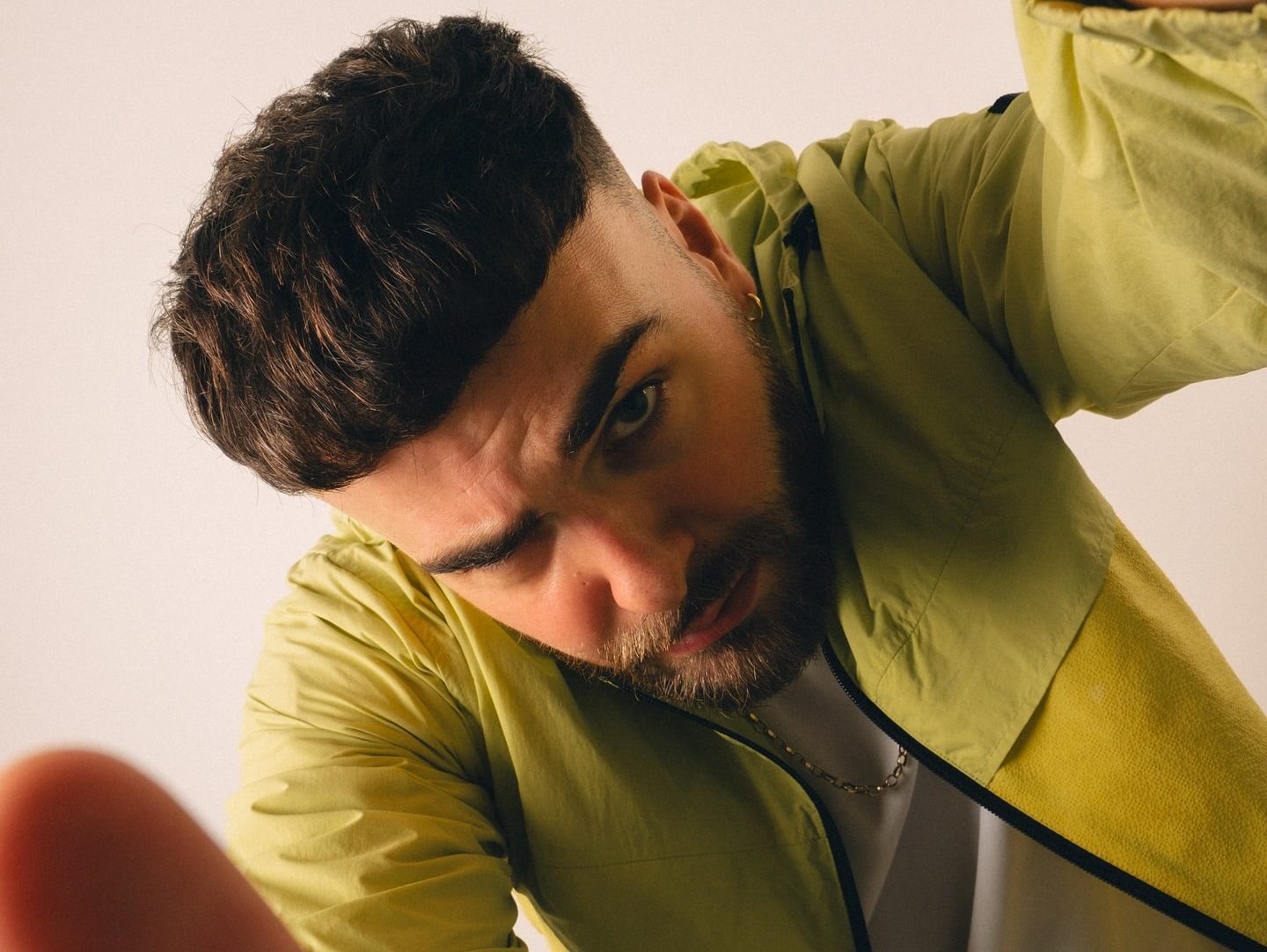
Danny L Harle breathes the air of other worlds. He is dance music’s commander on high, the solar star around which every surrounding planet orbits.
There are great, gleaming fissions of pop music to dazzle the senses; tectonic rumblings stretching across the landmarks of rave; sounds so bright, so strange and unnervingly beautiful, that you feel as the same erosions between dreams and reality as if you were a child again. And you can’t tell the story of 21st century pop music without it.
When a song has been touched by Danny L Harle, he’s the kind of artist who leaves his fingerprints all over it. A foundational figure in the PC Music collective, the alien vistas he created alongside A. G. Cook have risen from mockery to redefining mainstream pop. Over the course of a decade, he has been at the helm of culture-tilting records for artists including Caroline Polachek, Dua Lipa and oklou, as well as landmark tracks for Charli xcx, PinkPantheress and Clairo. His sound his so vivid, his vision so total, that he doesn’t produce as much as he crafts entire wonderlands for his artists to live in.
Get the Best Fit take on the week in music direct to your inbox every Friday
And yet only now is Danny L Harle ready to share what he describes as his "debut album". Cerulean – blue, a “darkness tempered by light”, as described by Goethe – is not merely a statement of identity, but a love letter to everything he finds beautiful.
“It sounds like something that doesn’t quite exist, so therefore you kind of invent it in your mind,” Harle shares. “I think that process is very magical.” It’s a climate of uncanny beauty, ruled by the dancefloor as equally as patterns which trace back to the Renaissance; a transmission from a far-flung future which is not as estranged from the past as we might believe. Its opening track, “Noctilucence”, carries all the beauty and violence of opera: fairy dust strings obliterated by buzzsaw synths.
“I always thought I would be making music as a kind of craftsman for other people,” he says. “But through experience, I realised that the best reaction I get from people listening to my music is when I write the music that I like the most. It’s ironic, but I had to shift inwards in a way that felt quite bizarre. There’s a distillation I had to get to grips with to write this album, so understand the statement I want this music to cleave out – it’s my way of expressing my love for everything, and what I see as my gesture in this world.”

Cerulean is also a staggering record of Harle’s collaborators, a summit of some of the most singular artists in modern pop. Dua Lipa, PinkPantheress, Clairo, oklou and, of course, Caroline Polachek are among the voices who colour it. “I’m very particular about who I can work with,” says Harle. “I can only work with people if I have a vision for what they could do... the kind of voices I like are usually the ones where they have their own style of melody – where only they could sing it the way they do.
"I guess the kind of melodies that I like use the voice as an instrument, and the lyrics as a half-abstract canvas. All these artists do that in their own music and are the masters of their craft. I honestly can’t really believe it, looking at the list of people. These are my favourite artists who aren’t jumping on any bandwagons, they’re creating source material. It’s very meaningful when people like that trust you.”
The last time we saw Harle in command of his own vision was with 2021’s LP, Harlecore – a conceptual journey through the history of rave culture, guided by four avatars which capture each concoction in his mind-melting club “rooms”. With DJ Danny, MC Boing, DJ Mayhem and DJ Ocean, each persona captures the spirit of hardstyle, gabber and happy hardcore which was life-giving for the pandemic hangover into which it was released. The reason why Harle believes Cerulean is his debut album, however, is because while Harlecore was “a laser-focused expression of a specific thing”, this takes a step back and takes in the totality of the artist he has evolved into being.
He feels Cerulean walks the line between a museum and a gallery – the distinction between the two is something which has often interested him. Notions of the past and future are common to both. “There’s a sort of commonly held belief that people have become cleverer over time; that in the past, people were simpler. But I believe everybody has always been as intelligent, thoughtful and emotional as we are today. My brother calls it ‘The Same Theory’ – and that’s with the belief that one can almost tune into the currents of making things and understand why we’ve always been making them. I think there’s this quite poignant relationship with history, especially when you hear a chord sequence that is hundreds of years old and it sounds like it could’ve been written yesterday. It goes against this idea that the history of music was developed in this linear fashion.”
Though Harle is the son of saxophonist John Harle OBE and studied classical music at Goldsmiths, University of London, his thesis was chamber music that combined traditional music instruments with video games consoles playing the likes of Zelda and Street Fighter. Classical music and electronic music are not worlds apart, to Harle, but kindred spirits. He points to mavericks in the Renaissance era writing microtonal music with keyboards with hundreds of keys, and the saw wave sound which can be traced back hundreds of years bringing us to right now and beyond, with Cerulean.

“Electronic musicians have been making stuff that is basically classical music for a very long time, but there hasn’t really been the terminology to describe it,” he explains. The classical elements in Cerulean were often mistaken as interludes. “I think a lot of the words that exist in electronic music are quite undermining – and intentionally undermining. There’s ‘beatless’, which is just defining something but what it’s not; ‘ambient’ is arguably undermining for music that isn’t designed to be listened to in that style.
"Ambient is a beautiful tradition that I love, but it’s a certain listening style – in fact, the classical mode of listening, which is all I define it by – which is fully engaged listening. You’re open-minded, not requiring immediate satisfaction but engaging with the entire piece of music. Whereas with pop listening and dance listening, you expect to be satisfied within the first 30 milliseconds of listening to it. A classical composer, however, can command your attention for three hours.”
He points to Aphex Twin and Burial as blazing a trail for fully-engaged listening for electronic music – as serious work with warrants attention. “There’s something I find particularly emotional about the kind of harmony you can explore in classical music, but by that same token there’s something I find particularly emotional about the sounds in electronic music. I wanted to combine these things: the types of harmony you get in the Elizabethan Period and the Italian Renaissance with electronic music as we know it today. One of the challenges of the album was fusing these things together which didn’t diminish them.” The harmony Harle is drawn to is constantly moving, and with dance music you have to start repeating yourself to reach the “satisfaction feeling”. With “Laa”, he solved that with a constantly modulating chord sequence which was reflected often in Renaissance choral music like Monteverdi’s Crucifixus.

There has always been a tension between the alien and the organic; a question of humanness and “feeling” which electronic music has had to earn. “I really like that confusion sometimes,” says Harle. “Especially when you hear a sound and it’s not clear if it’s a real person or not. I think that’s fantastic.” But there is something undeniably human about electronic music, even when it feels so far removed. “When the term EDM came from America, they had to define it as electronic music – almost as if all the techno they’d been listening to all these years wasn’t electronic. It’s a continuously novel idea that music is electronic. What people don’t realise is that even the non-electronic music they’re listening to is coming through speakers which depend on electricity. Not only that, there is electricity running through their bodies and coming from their brains. Electricity is a completely organic and natural thing.”
Harle is particularly fascinated by the sawtooth wave – a highly harmonic waveform which makes dance music feel so rich and full. “It’s on the saw wave where you can put a 500-year-old chord sequence and it sounds staggeringly modern. I think the magic [of electronic music] is you can’t see where it’s coming from. There’s a sort of mystery to it. I guess maybe I require a level of disconnect, strangely, to feel emotions. Whereas I think a more conventional listening experience for people is a feeling of direct connection, like somebody with a guitar and singing at you – they want as close to that experience as you can get. For me, though, I’ve never found somebody singing in a live performance to be the ultimate form of music. My most profound musical experiences have nearly always been on my own, listening on headphones or in a dark club. There’s some sense of isolation, an internal experience of the music, rather than an external connection with a person.”
Harle sees expressions of other artists who feel the same way. He thinks of the phantoms of other players in video games; the gesture of a shared experience, alone together. When he considers the visual world of Cerulean, he was influenced by films which existed in “the threshold between reality and dreams”. Disney’s 1940 animation Fantasia, a ritual watch every weekend for his daughters, is a classical concert animated with scenes of wonder. It’s this wondrousness he seeks to create in his own work. “This is a thing I share with oklou in particular,” he notes. “Creating something that has a sense of purity or child-like innocence that almost makes me cry every time it’s so perfectly evoked. I found myself bursting into tears a lot at Disneyland. It crosses the boundary so perfectly between reality and dream. It’s just so amazing when a child hugs one of their favourite characters, and you can see there’s this moment where they find themselves living in a fantasy. For me, it corresponds to that musical feeling of transportation. It’s the half-abstraction, which I think is the genius of Fantasia. The shapes evoke something, but the mind fills in the blanks.”
His own daughters, Cosima – then two-years-old – and Nico, six, lend their voices to the album. On “Island (da da da)”, an accordion shanty is elevated by trance saws; her voice is crystalline in a way that only a child’s can be. “I wouldn’t have put them on if they weren’t good, you know,” Harle laughs. “Nico has an incredible voice, the kind of voice I really like. She just asked me one day, ‘Can we go and record some music?’ It must’ve seemed very casual to her, when in fact this was all very serendipitous because I had a song I needed a vocalist for. I taught her a song on the bus on the way to the studio, and she was perfect for it.”


Cosima features on two of the orchestral tracks. He captured her voice when he opened the voice memo app; she was delighted at her voice appearing as a waveform. “She just said, ‘It’s music!’ – and I really like the joy of children discovering what music is at such a young age,” he says. “To see a child laugh for the first time is a very profound thing; there are so many awful things for children to discover, but when they discover these miraculous things it’s a privilege to witness.”
His daughters’ relationship with music is something he describes as very honest. Nico has started to become fascinated by the music her father makes – not a thing that he intended. “I’m interested in people being individuals,” he says. “I’m not necessarily interested in making people have shared values musically with me. But with that said, they’re both interested in the same things and respond to music very strongly.” One of the great points of pride in his career is that children have always loved MC Boing. “I do think in my old age I will probably look back on MC Boing as the purest music I have ever made, or ever will make, because of the animal reaction that it gets from children,” he says.
Certain tracks from Cerulean were welcome accidents. His collaboration with Dua Lipa, “Two Hearts”, was written during the sessions for Future Nostalgia. He wrote the instrumental the second he found out he had time with her, and the melody was later written with her and Andrew Wyatt. “It was so clearly in my world and there was too much of my own personal vision in it, but it was through writing that song that she wanted to write with me further even though she knew it wasn’t right for her own album,” he shares. “It’s unbelievable that she would then let me use the song for mine. I’m just so glad it gets to see the light of day. I know she found it to be quite a special one as well because she suggested we finish it, so that was an indication for me that she felt the same about it.”
His track with PinkPantheress was born in a similar way. “I think that slightly Elizabethan inflection didn’t quite fit with what she was doing at the time,” he reflects. “And then I made a version of it that I played at the PC Music 10th anniversary concert where I was wearing a suit of armour. She was there and she really liked the track, so we finished it together. That song became an ambassador for that album, I suppose, because of all the sections and the kind of odyssey it goes on. It was a slow development which ended up representing the album very well.”
With Caroline Polachek, however, his relationship is that of co-producer. She’s equally as involved in the atmosphere and structure as Harle himself: “She is sort of microscopic and visionary in the way she sees things, and that’s why she is so good. She’s the artist I collaborate the most with on every layer."

Harle’s ambitions for pop music have remained constant: really extreme. “The only revelation I’ve had is that the best way to make something is earnestly, rather than with being tongue-in-cheek or self-aware,” he says. “My favourite avant garde culture hasn’t come from people trying to make intentionally avant garde things, but has just come from people making things that are very extreme and serious – and the end product has inherent experimental properties because they’ve been made with such a singular approach. I guess this slightly changed my mindset in terms of the way I make things.”
When he reflects on the legacy of PC Music, the thing he is most pleased about is that people realise they weren’t joking. “It’s mad to think back on the early club nights we used to play, me and A. G. [Cook], where we used to clear dancefloors playing this music – and now there are specific club nights dedicated to it. But that’s just how people come to understand things. There has to be a shared language and a way of dancing and a way of talking, because everything comes down to an atmosphere of consensus. When it reaches a large number of people, there has to be a way in which it’s understood. At the time, it was just a very small group of people who were attracted to these sounds. And if the feeling comes from a real place, as it did with me and A. G. – a true love of all of these sounds and the culture surrounding them – then it’s only a matter of time before it starts to rub off on people. Genuine experiments were happening at the time, with all this ripeness for disruption.”
Pop music is now a respected artform, but at the time of PC Music’s inception, it was controversial to say it so boldly. “It was like, ‘Yes, we like Max Martin’s production. We think it’s fantastically done’. You can hear he’s using harpsichords, constant modulations in the chorus – very advanced stuff. But that kind of thing was genuinely a novelty for people at the time.”
But despite the zeitgeist-defining release of Brat from the collective’s most successful affiliate, Charli XCX, Harle feels that the mainstream consensus of pop music remains conservative. “I think it’s fantastic that artists like Charli [XCX] are getting such mainstream success; it allows for an understanding of alternative music and culture in the mainstream which I think is a fantastic thing. It’s particularly good that now she has a platform where she can execute her vision, which is constantly moving forward. You can see that by the fact she’s started engaging with films the second she got musical success. Every move she has made has surprised people, and I think she’ll continue to do that for the rest of her life.”

If you look at what continues to dominate the charts, he says, this is not the music which is changing the face of pop. The outliers are. “We live in a more pluralised culture where these outlying explosions can make their way into the popular imagination,” he says. “I think that’s a great thing about social media, and something I really enjoyed about TikTok in its first iteration. There was much more of a sense of chaos. It was really not controlled by anyone, and that’s what I see as one of the last truly avant garde moments in the popular imagination where there was a flattening of culture because nobody knew what these sounds were that were becoming popular. There was no cultural baggage. It was a fantastic time. I’m not interested in disruption for its own sake, but it’s often quite hard to imagine how disruption can even exist with walls being constantly being broken down.”
And yet, not by design but by blind instinct, Danny L Harle continues to be a disruptor. Cerulean embodies it all - simply as a statement of everything he loves. The alien beauty of his music has never felt more human. The conclusion he arrives at is startlingly simple: “You can only really do your own thing.”
Cerulean by Danny L Harle is released on 13 February via XL Recordings








 English (US) ·