
 1 month ago
17
1 month ago
17
In 2019, two sisters from Canada made an album called Big Time.
They sang over each other in a daze of icing-sugar harmonies. They smacked open chord inversions on hollow-body electrics with the coltish energy of being young and hastily getting down ideas because life won’t wait. They listened to albums like Dude Ranch, but also pulled ‘sophisticated’ reference points from the archives: Liz Phair; the spiky, violin-scorched pop of That Dog; the few second-wave emo bands whose makeup wasn’t 100% dude (that’d be Rainer Maria and Jejune); plus one-of-a-kind masterstrokes like Any Other City by Life Without Buildings, and Superchunk’s Foolish.
Big Time was disarmingly passionate, potent, and immediate – it became one of my favourite albums. And then nothing happened.
Or, rather, something happened for half of the duo. In 2020, Madeline Link’s other project – PACKS – took off, and the younger Link has since released three albums and an EP on Fire Talk.
There were never hard feelings. Eva and Madeline remain each other’s go-to for everything, including music – Eva directed one of PACKS’s music videos, they swap demos – and they live ten minutes from each other in Toronto. But it did take the older sister a minute to recalibrate. Triples had been a fun, lightly subversive name for a duo. Could Eva Link even be ‘Triples’ as a solo artist?
Get the Best Fit take on the week in music direct to your inbox every Friday
“I’d been so used to writing, recording, everything involving my sister – us working together in that capacity – so I really needed to re-focus and reconsider what that looked like,” Link tells me. “It definitely took a while to get that flow back.”
She finished an illustration degree, wrapped up her acting career (you may have seen her in some of these), and pivoted into a gig as an in-house designer. Still, she never stopped voice-noting riffs and scribbling lyrics. It was just tricky to execute full songs without people to reflect back her ideas.
“It’s interesting – the gap between being a songwriter, having your voice, your acoustic guitar, and being able to write your songs,” she shares, “but then the next step of having the resources and collaborators and being able to actually get that stuff down. Especially if you want your sound to be that of a full band. Definitely at the time I was just like, ‘We’ve got to keep this sound going.’”

After five years, “So Soon” cut the silence. It sounds made for the soundtrack of 10 Things I Hate About You – a girls-to-the-front, feel-so-good power-pop ideal that matures the Big Time template with new collaborators and punch. But it was also the product of “we’ve just got to get a new song out there” anxiety on Link’s part. Looking back, she thinks it was maybe not the best move – she prefers it when songs fall into conversation with one another, telling a bigger story.
That’s the case on the Every Good Story EP, out tomorrow. A couple years on from the standalone “So Soon”, it’s a truer continuation of Big Time. “I feel really excited to have a collection of songs come out, because it definitely establishes, okay, this is really what the sound is going to be,” she says. The after-school lofi approach she and Madeline took has given way to bigger-screen production: lairy ‘guitarmony’ solos seethe atop layers of glossy pop crunch, though the heavy vocal harmonies USP of Triples’ early work bridges across, thank god.
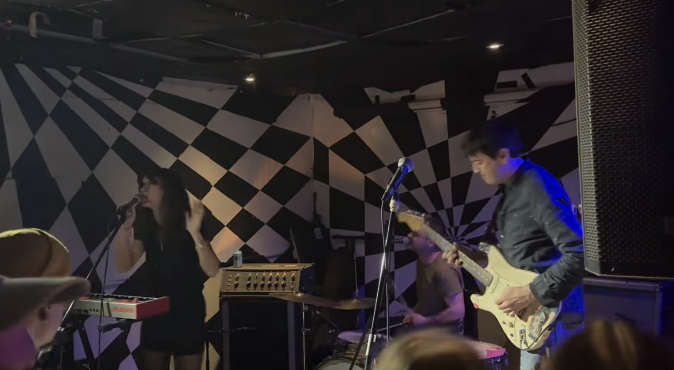
“With Big Time, because it was just me and my sister, there’s a little more sparseness to it,” she explains, “really focusing in on that rhythm guitar and drum sound, which is how we sounded live. I think both of these releases emulate that live sound that’s progressed from then to now. If you see Triples now with the four-piece, this is what it would sound like.”
Get the Best Fit take on the week in music direct to your inbox every Friday
Triples couldn’t be a duo, but it could be a quartet. Adding bassist Owen Hooper, guitarist Kurtis Marcoux, and drummer Lucas Horne, this EP is Link’s go-for-broke leap back into a world she’s strayed from. Reflecting on the era that produced Big Time, she says, “I was working at a cafe, and that lifestyle felt a bit more holistic. We’re doing some work, and then we’re playing shows, and then we’re coming home and working on art, and then I book an acting role. Doing all those different things is what I like, but now I’m more locked into the nine-to-five.”
Much of what Triples’ music is about, Link explains, is this idea of “forgetting who you are and then remembering who you are. As we get older, it can be harder to remember that stuff, and it takes a lot of effort to stay true.” Things that help: listening to Guided By Voices and Elliott Smith, the music that’s accompanied her the longest. “Or rereading old journals. I’m big on reminiscing and having nostalgia,” she says, “even for five years ago. I’ll go look back at photos, and I think that can be interesting for songwriting too – just the contrast between how you felt about stuff then and now, the passing of time.”
Every Good Story fizzes with these know-it-when-you-feel-it feelings, but it’s also about pressing ahead, accepting that you can’t bring forward every part of yourself. “Old Routine” sets the scene – it sounds like hugging mum goodbye in the front drive and then spinning away from everything you know with a backseat full of clothes. With those flangey, jangly open chords, it also links old-days Triples with this new iteration – the difference being a face-ripping guitar solo after the first chorus. It’s the oldest song on the EP, an idea Link and her sister tinkered with years back.
“Generally, it’s about wanting to decide,” Link explains, “and make decisions about your life and about your routine that end up changing the way you live your life forever. It’s a triumphant feeling of: I’ve decided my life is gonna change.” And if it does sound misted with a light rain, Link says that “melancholy almost comes from reflecting on how things were,” rather than any sadness about the present.
Link always writes for the place she has in her sights; she knows that everything is going to be fine because she works hard to make it so. “When I write songs I feel very drawn to mantras,” she tells me, “little reminders, things you can tell yourself, to pull yourself out of those bad mental moments.” On “Gonna Be Good” – the second single from this EP – for example, the mantra is “I’m not guilty of anything.”
“It’s about feeling depressed,” Link elaborates of “Gonna Be Good”, “but I can’t write a song about that feeling alone, because to me it’s giving into that negativity.” Instead, she prefers to simply decide that she’s okay: “be defiantly like, I’m gonna decide that I’m good right now. It’s boring to dwell in that depressed feeling and tell people about it,” she says. And so that line – “I’m not guilty of anything” – is about how “when you’re feeling anxious, you always have this feeling of guilt, but actually there’s nothing for me to worry about. I’m creating problems. It’s a cheeky way to be like, get out of my brain, bad thoughts.”
This is a guiding principle for Triples’ new era of music, and generally for Link in daily life. She has specific playlists of mantra-led tracks, citing “Josie” by Blink-182 and its incessant “I know that everything’s gonna be fine” refrain. “Extraordinary” by Liz Phair comes to my mind, the “I am extraordinary” hook. In a way, these are placebo songs. If “Josie” can trick you into believing everything is gonna be fine, imagine the effect that comes from writing these songs yourself.
I turn to Triples when I need a reminder to live not selfishly but in my own life – to inhabit the character that’s driving these daily stories. It can be easy to discredit or dissociate from our emotions and achievements when weighed against incomprehensible global events, even the perceived success of peers. But a touch more self-absorption can be helpful sometimes. “I overthink my own life and how things are supposed to be going,” Link confirms. That’s why the thematic link between the songs on this EP is, quite simply, snapshots of her going about her life in Toronto, she tells me – something the aesthetic direction of the EP ties to.

But more existentially, she also overthinks the compromise that “probably a lot of musicians feel: trying to balance the way you make
money in your career with wanting to pursue your passions and what you actually like to do.” As Link renavigates that increasingly rubbled roadmap for independent artists, she’s relying on the instrument that gets her closest to self-belief, to creative fulfilment: her voice.
“This is the thing that I care the most about with music,” Link says of vocals – that goes for the words, the performance, the submeaning beneath the delivery of the lyrics, the harmonies. All of this totals her favourite part of her process, and of others’ music. Whether it’s Paul Westerberg’s huffed croon or Elliott Smith’s mournful murmur, she’s captivated by singers that stick the emotional landing every time, without sounding like they laboured over it. And this is the same thing that makes Triples’ music resonate: there’s an invincibility and tangibility in shooting from the hip, in assuring yourself – and everyone else – that you believe every word.








 English (US) ·