
 1 month ago
30
1 month ago
30
Ahead of this year’s fast-approaching edition of Winter Music Conference, esteemed industry leader David Ireland sat down with EDM Identity for an exclusive interview.
Launched back in 1985, Winter Music Conference (WMC) has long operated as the electronic music industry’s most revered annual gathering. Over the course of four decades, WMC has served as the connective tissue between independent labels, emerging artists, and the broader dance music ecosystem. After its 2025 comeback, the conference is now setting up shop at Downtown Miami’s Kimpton EPIC Hotel for three full days of industry panels, pool parties, keynote speeches, and—to cap it all off—the inaugural International Dance Music Awards (IDMA) Gala.
At the operational helm of WMC’s 36th edition is David Ireland, a veteran media executive whose career in electronic music dates back to the mid-’90s. Ireland founded BPM Magazine, a grassroots rave music publication, in 1995. In the three decades since, he’s held senior marketing roles at Diesel and Victrola, co-founded Magnetic Magazine, and served on Audiopool’s advisory board. Now, alongside UK-based production outfit We Group London, Ireland is tasked with restoring WMC to its former stature as the preeminent industry forum during Miami Music Week.
Thus far, this year’s conference has unveiled two waves of highly impressive programming. In addition to a refreshed slate of panels and keynotes, WMC 2026 will host a gear hall featuring exhibitions from Telepathic Instruments (Kevin Parker of Tame Impala‘s newly launched synth company), Allen Rigby-Jones’ Union Audio, and IK Multimedia, among others. AlphaTheta will be demoing its new RMX-Ignite hardware while L-Acoustics showcases its latest spatial audio technology at the pool parties. On the promotional side, SoundOn will present a new networking concept at TikTok’s “Indie Label and Industry Mixer” on Wednesday. Essentially, new artists and label reps will be able to connect face-to-face over demos, release strategies, and career advice.
Ahead of Winter Music Conference, David Ireland sat down to discuss electronic music’s professional landscape, the conference’s reinvigorated programming, and the entrepreneurial spirit that carried him from bedroom publishing to running the biggest forum in dance music.
You started BPM Magazine out of your bedroom in ’95. Now you’re running WMC’s 36th edition. What’s genuinely better about the electronic music industry today, and what have we lost?
It’s kind of a full circle for me with Winter Music Conference, and it’s kind of surreal on many levels. BPM Magazine started as a full-blown rave ‘zine, patched together on newsprint and circulated out of the back of my Toyota Tacoma in the mid-90s. It was all grassroots back then and truly underground. My first WMC was in 1996, and I remember vividly being so broke that we had to sneak in and hand our first copies of BPM through the fence, as only one of us made it to the pool.
WMC, at the time, was the only thing happening in the US, so it was an absolute must for electronic music industry types. My career literally started here, as it was a place that we connected with all the labels, DJs, and heard all the new tracks dropping on promo, so this event was crucial for all the independent dance labels trying to break 12” singles. DJs would almost get into fist fights over hot promos from all the labels, as there was a finite amount of vinyl to go around.
I think coming up during the early years was exciting, as it was more communal and driven by subculture; we all knew one another. Was it better? That’s not the word I would use; it was just a totally different experience.
What we have lost is community, in-person networking, and connection. We are striving to bring that back and create opportunities for brands and labels to connect with each other and with the next generation of industry hopefuls and artists. There are so many layers now that electronic music is so massive, but that doesn’t mean we cannot foster community and human connection. When you have one of those moments when you meet that one person, or make that one connection that could change everything, it’s incredible.
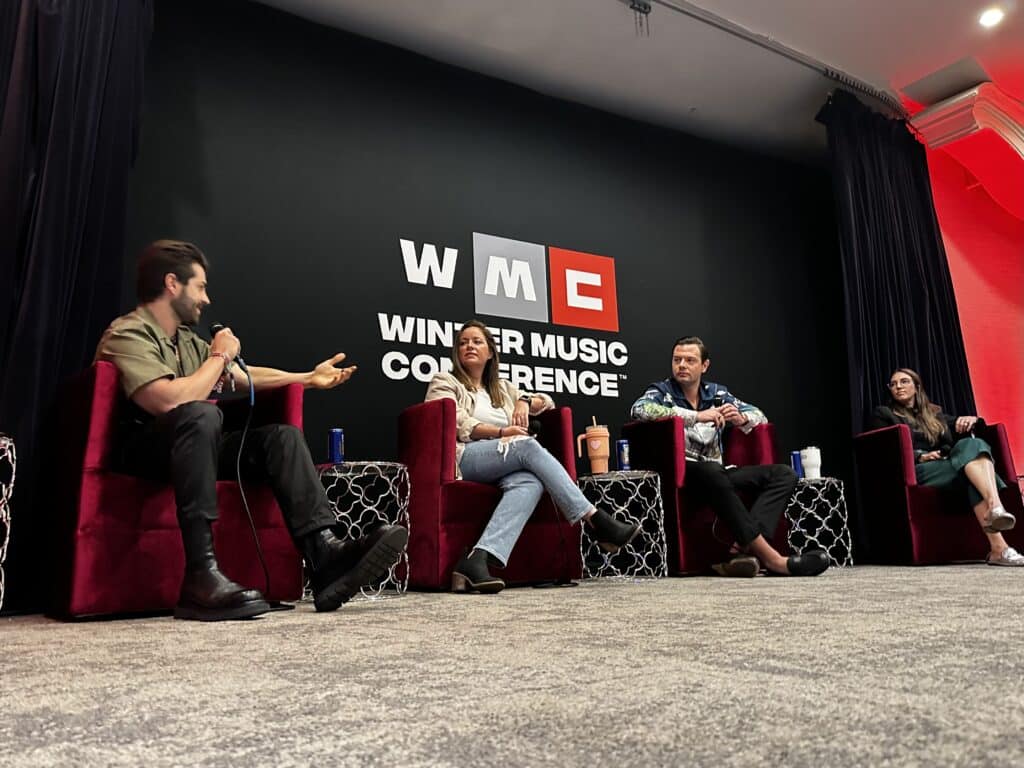 Photo Credit: Winter Music Conference
We Group London has taken over WMC operations this year. What does that new structure actually change about the conference?
We Group London is a company that produces festivals in the UK and is well known as one of the best in the industry. That know-how is being applied to the Winter Music Conference and the Miami Music Week Hotel. In partnership with Beatport Live, L-Acoustics, and AlphaTheta, we will be offering incredible pool parties with the WMC Pro badge, and that has not happened in a very long time.
The production quality will be top-notch, the panelists and subject matter will be thought-provoking and meaningful, and We Group is striving to bring back some of that DNA that made this such an important global event. We are creating an intersection for those taking their first steps in this industry and for more experienced individuals seeking community and content to address the challenges we face.
This year’s WMC has producers handing USB demos directly to label A&R teams. When did you decide the conference also needed to serve artists?
Supporting new artists has always been at the core of WMC’s values, so this is nothing new, to be honest. We are trying a new formula with a path for artists to take a swing at the big time, a more expedited way to get their demo heard.
You’ve been on Audiopool’s advisory board for almost two years now. For someone who doesn’t know the platform, what is it, and why should artists care?
Audiopool has just launched in beta and offers a new promotional path for artists and labels. It’s been a fascinating journey with several iterations, and they have come to market with something truly unique, bringing the worlds of Web3 and traditional promotion together and introducing a bit of democratization to music promotion and discovery. It’s always fun to be part of companies with a unique vision that want to disrupt the status quo in a positive way for artists. If you are looking for a new lane to promote your music, it’s something worth checking out.
BPM to Overamerica to VP of Marketing at Diesel to Magnetic to WMC to CMO at Victrola and back to WMC. What has bouncing between fashion, consumer hardware, and music taught you that staying in one lane wouldn’t have?
That’s a great question, and I’ll do my best to answer it. My path began when I stumbled into a rave in 1992, and BPM started in 1995 with a love for electronic music and the rave and club cultures. I started a magazine in my bedroom, which, in itself, could only be done with a bit of insanity and an all-consuming drive to be part of something.
I was broke all the time, funneling every dime into making BPM happen. When you take that route, you learn about everything and how to do everything by design, because you don’t have any resources. I learned to sell by chugging coffee, picking up the phone, and cold-calling labels. I learned marketing by pushing my own product, and then that all just converged into a skill set forged from experience.
I studied journalism and advertising at SDSU, and that was the foundation for everything, but the “doing” by any means necessary is what allowed me to find lanes in different industries versus just being a one-trick pony. Being an entrepreneur sounds exciting, but it’s a path that breaks many and is not something most people want to put up with. For those who can stomach it, the rewards are significant, but there were many a time I almost hung it up.
Being part of so many different companies, both as clients and working directly for them, allowed me to see marketing from different angles, and from that came some universal truths.
If you could go back and tell bedroom BPM Magazine David Ireland one thing about how this industry would evolve, what would it be?
I don’t think I would say anything, maybe just a little nod to tell myself I was on the right track. Part of the process is just to follow what you love, and if you wake up inspired and ready to go to work, that’s something truly special. Falling down and finding your own path is part of the process. The only way to make it in today’s electronic music industry or as an artist is to be unrelenting, innovative, and passionate about your path. Nothing will come easy, and if you wake up one day not feeling it, then listen to those feelings and navigate accordingly.








 English (US) ·